Overview
Shing lets people lend, rent, sell and give away things in their building, their club or their group of friends. Alexander van Riesen and I have known each other since my Yaytrade years. At the end of 2025 we sat down with a prototype made in Lovable.
My Role
Scope
- 629
- commits in ten months
- 245
- API endpoints across 17 services
- 4
- products on one backend
How it started
A backend that stops starting over.
The first Shing was a prototype in Lovable. It showed the idea well. It could not keep data, rules and users stable from one change to the next.
I set up the backend in Encore.ts with PostgreSQL. Encore declares the databases, queues and scheduled jobs in the code, so I was running in days and not weeks.
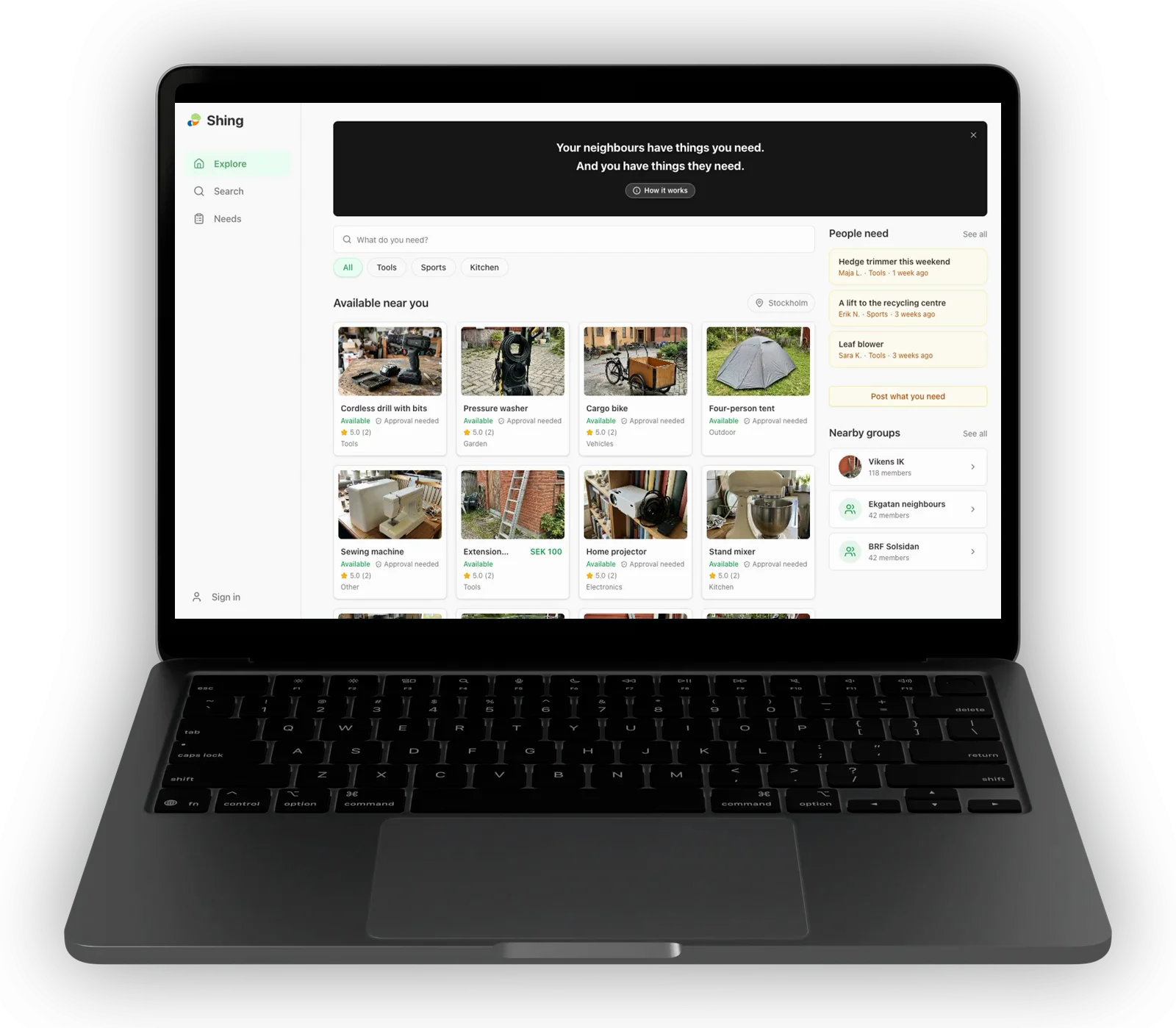
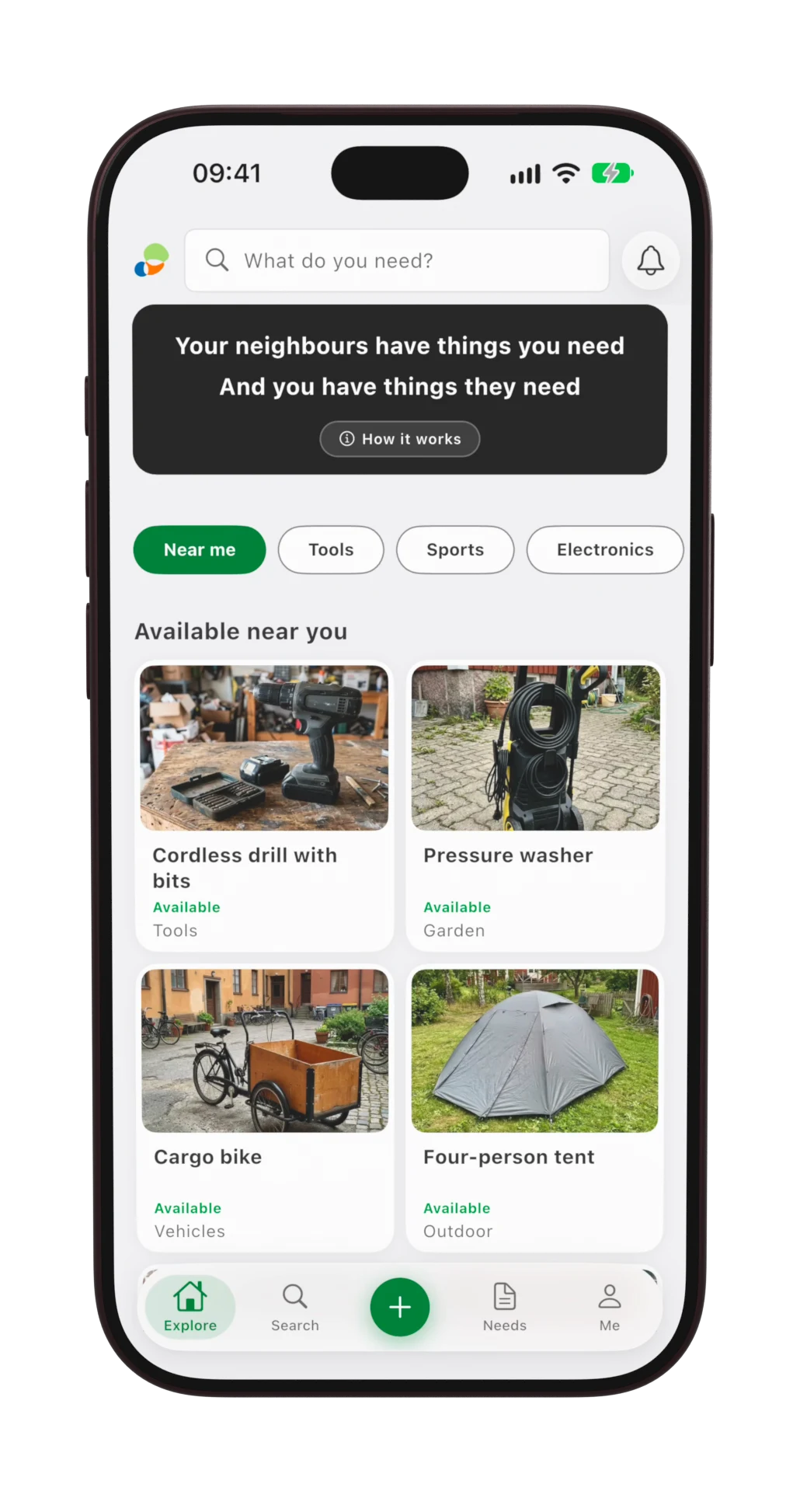
The platform
One backend, four products.
The backend holds 38 tables and 63 migrations. Every row belongs to a tenant, so one deployment can serve several organisations with their own branding and features.
On top of it sit a web app in Next.js with 34 pages, an admin with 18 pages and a mobile app in Flutter. The marketing site reads real listings from the same public API. Sign-in runs on Clerk and payments on Stripe.
What is in it
A photo is enough
Take a picture of the thing. AI names it, describes it and puts it in the right category, so a listing takes seconds.
Search in plain words
Ask for what you need the way you would ask a neighbour. The search understands the sentence, not only the keywords.
Actors, not just users
A person, a group, an association or a business can own things. One user can act for several of them and switch between them.
The lending flow
Ask for dates, get a yes or a no, pick the thing up and return it. Both sides see the booking the whole way.
Lend, rent, sell or give away
A listing can be a loan, a rental, a sale or a gift. The same thing can move from one to the next.
Payments through Stripe
Stripe Connect takes the payment and checks the seller's identity. The money goes straight to the owner, so Shing never holds it in escrow.
A needs board
People post what they need. A neighbour who has it answers.
Trust
Reviews after each loan, incident reports when something breaks and a protection scheme for covered loans.
One loan on two phones, from the photo to the reviews.
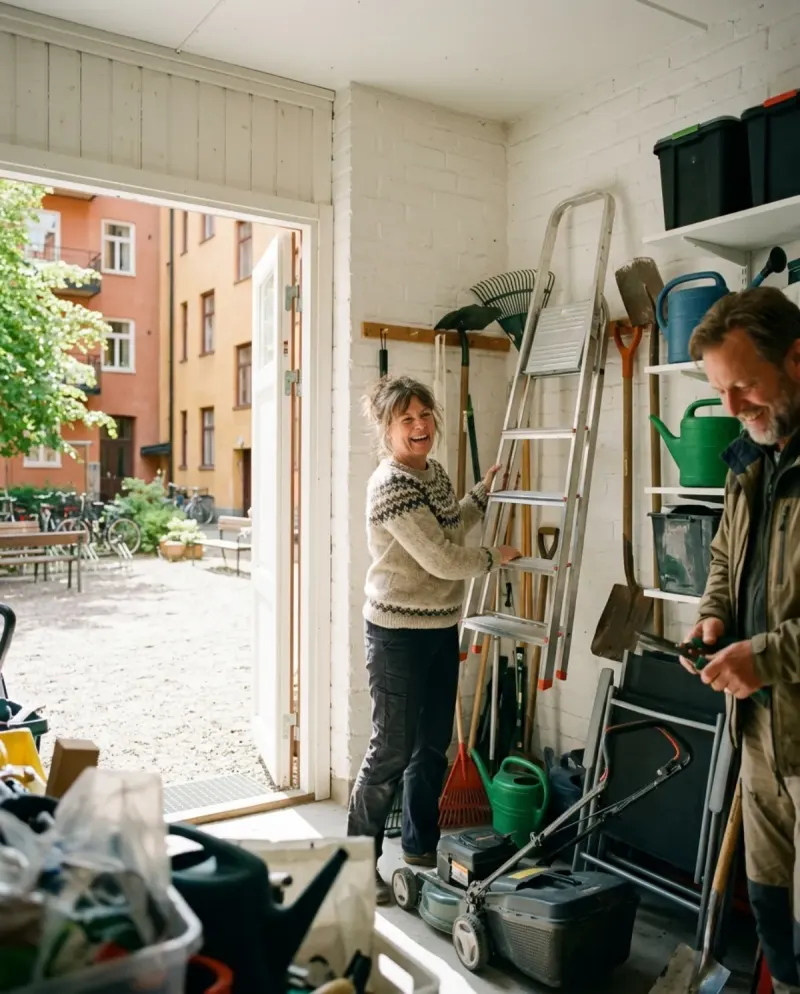


Made for the places where people already share: the housing association, the club and the group of friends.
Design
Proven patterns now, a real design next.
I did not have the time to build a design system and design every view properly. I let reference patterns from Mobbin carry the interface, and spent my hours on the platform under it.
Ari Tolonen is now setting the new design.
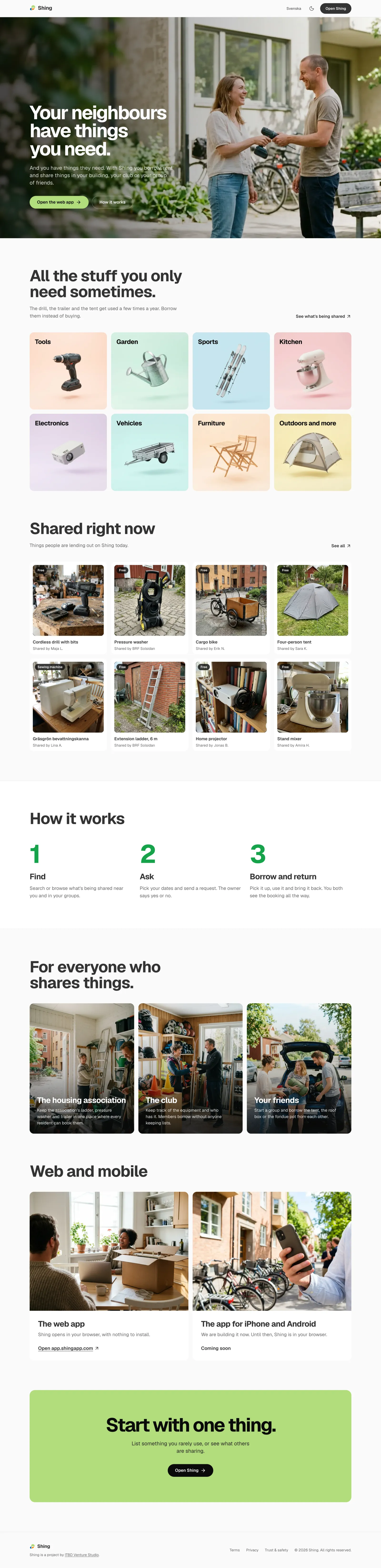
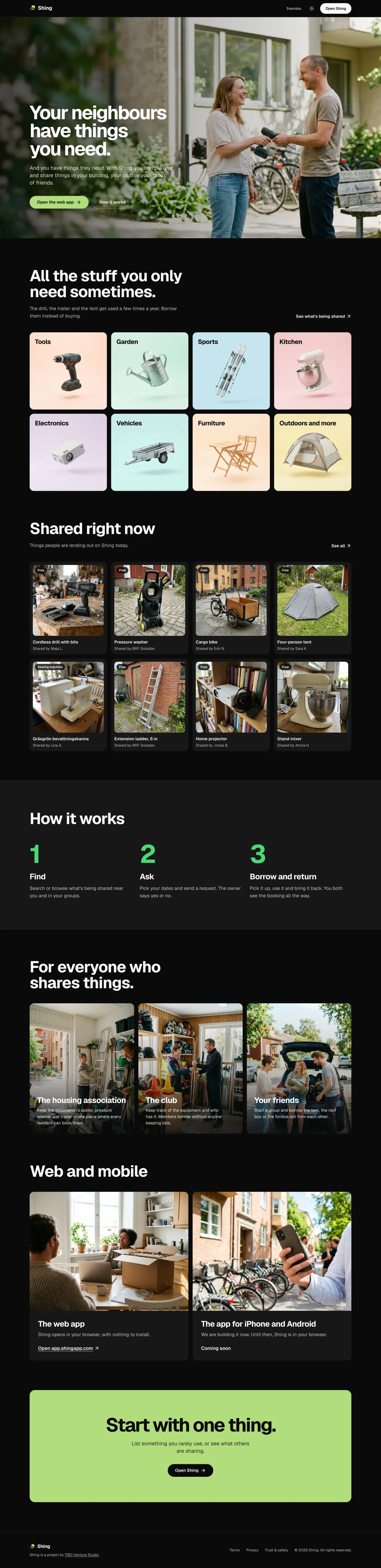
The new site at shingapp.com. Drag the handle between light and dark.
A few years ago this was a 500,000 to one million dollar build.
What it shows
It does not have to cost a fortune.
A platform like this used to need a team for a year: backend, web, mobile, admin and a site. Shing was built by one developer with AI agents, in the hours that were free.
That is the way I work at Kerber AI: senior people who direct agents and stay responsible for the result.
See how we work at kerber.ai ↗Process
Shing began inside ITBD Venture Studio, which is still my network. It never had a large budget or a full-time team. Alexander and his co-owner Janne Skarner run other things next to it, and so do I, so the project took time when there was time.
Decisions
Rebuild the prototype as a real backend
The Lovable prototype started over every time something changed. I built the backend on Encore first and put the rest of the platform on top of it.
Borrow proven patterns
There was no budget for a design system of our own, so the interface follows proven patterns from Mobbin.
AI agents as the team
I worked with AI agents the whole way. That is how one person could build the backend, the web app, the admin, the mobile app and the site.
Stack
Outcome
Ten months after the first commit, the founders run real demos for customers. A junior developer has joined to keep the platform moving with small updates, and Ari Tolonen is setting a new design. The mobile app is built but not yet in the stores.
A platform on a small budget
Big product, small team?
I build the backend, the apps and the admin myself, with AI agents doing much of the code, so a small company gets a whole platform.