February 4, 2026
Managing My AI Team From a Dashboard
How the Codex app changed the way I think about AI-augmented development.

I initially dismissed graphical interfaces for coding agents. The terminal was fast, familiar and already open. A desktop app sounded like another layer around the same model.
Then I started using the Codex app across several projects at once. The value was not prettier chat. It was being able to see StarDust, Aligno and client work as separate threads, leave tasks running and return when one needed a decision.
OpenAI describes the app as a workspace for parallel agents, with threads organised by project and isolated worktrees for changes in the same repository. That maps closely to how I use it. The sidebar is less interesting than the shift it enables: I can stop carrying every task in working memory.
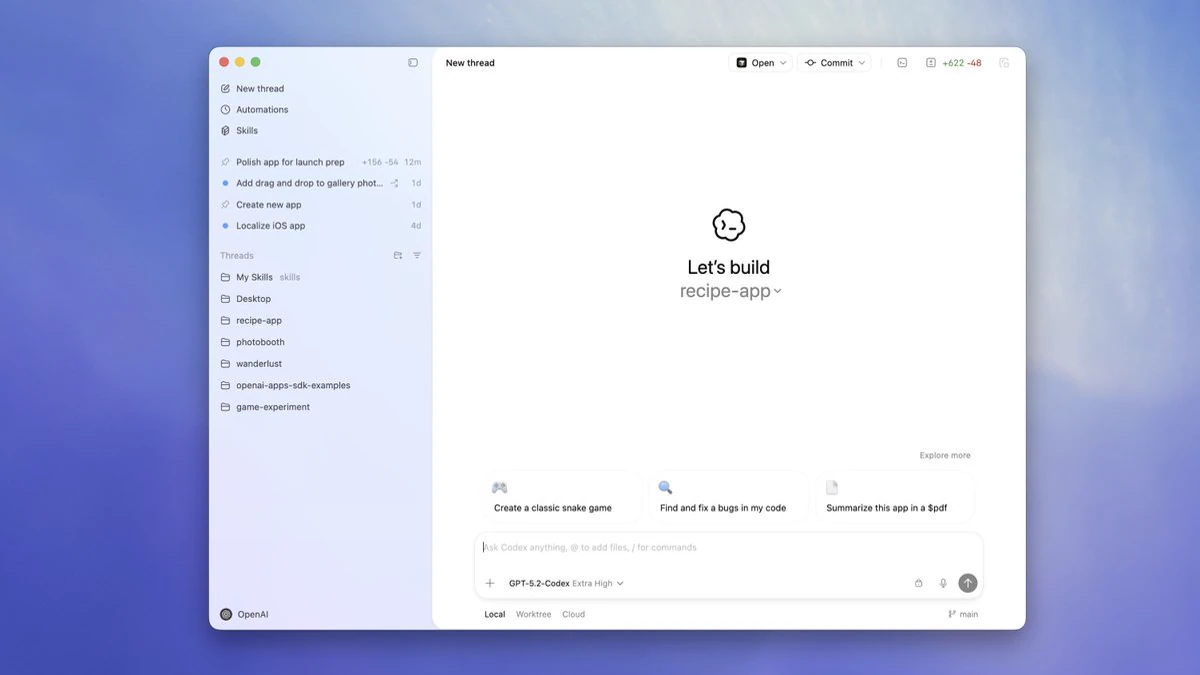
The experience feels closer to supervising a small engineering team than pairing with one autocomplete. That comparison has limits. Agents do not own outcomes and they do not notice political or product context unless I provide it. But the management problem is real: what is running, what is blocked and what needs review?
The Claude vs Codex reality
Claude Code remains useful when I want one focused terminal session and fast iteration. Codex is where I prefer to keep parallel work visible. Those preferences are about the surfaces as much as the models, and they change as both products change.
I no longer try to choose one permanent winner. I choose the environment that makes the current risk easiest to see.
Permissions are part of the interface
The tempting configuration is to remove every approval prompt and trust git to save you. I have run agents with broad permissions on disposable or recoverable environments. I would not present that as a default.
Version control can restore a file. It cannot unsend an email, revoke a leaked credential or undo an external API call. The useful setup is not maximum autonomy. It is enough autonomy for the task, inside a boundary chosen before the task starts.
This is where the app earns its place. Diffs, questions and approvals sit next to the work instead of being scattered across terminals. Visibility does not make an action safe, but it makes intervention cheaper.
Where I’m landing
My current split is simple: Claude for concentrated sessions, Codex for work that benefits from parallel threads and cross-project visibility.
The products will converge and the model rankings will move. The durable change is that software work no longer has to occupy one terminal and one train of thought. Once several tasks can progress at the same time, the scarce skill becomes directing attention: knowing what to start, what to stop and where a human decision is worth more than another model run.